Promoting democracy through Western education?
Governments, agencies, and foundations spend heavily to give students from developing countries a Western education — betting democracy travels home with them.
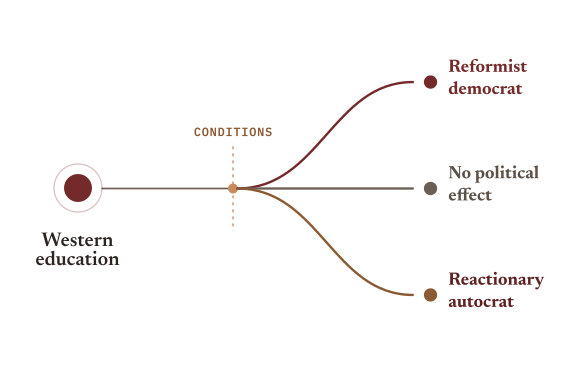
Beyond optimism and its mirror image
The project sets aside both Western-centric optimism and its pessimistic opposite, and builds a systematic account of the conditions under which Western education advances — or undermines — democracy in developing countries. Three connected studies put that account to the test.
Trainees over time
A longitudinal survey follows Western trainees and comparable peers from several developing countries, tracking how political attitudes shift.
Impact in power
Comparative historical analysis examines the influence of Western-educated citizens once they return home and rise into public life.
Western blind spots
A survey experiment probes the biases of the West-based stakeholders who design, select for, and fund these programmes.
The project's most public-facing work
The book
Following the questions, people, and places behind the research — for viewers well beyond the seminar room. Currently in production.
About the book
A five-part series
Following the questions, people, and places behind the research — for viewers well beyond the seminar room. Currently in production.
Watch the trailer
Explore the findings

Publications
Academic articles, working papers, conference papers, and two PhD theses.

Data & Tools
Open datasets, deposited at Harvard Dataverse, and a classroom simulation for teaching.

Policy & Media
Policy briefs and press coverage that translate the research for non-specialist readers.
Meet the researchers on the People page, or read the full aims and framework about the project.
Project updates
Educated abroad, sorted at home: How intersectional gender inequalities shape sociopolitical engagement among Western-educated returnees
Intersectional gender filtering in Western education: A critical-integrative review
Selecting whom? An intersectionality-based policy evaluation of home-state and foreign-state scholarship selection in Kazakhstan and Kyrgyzstan